
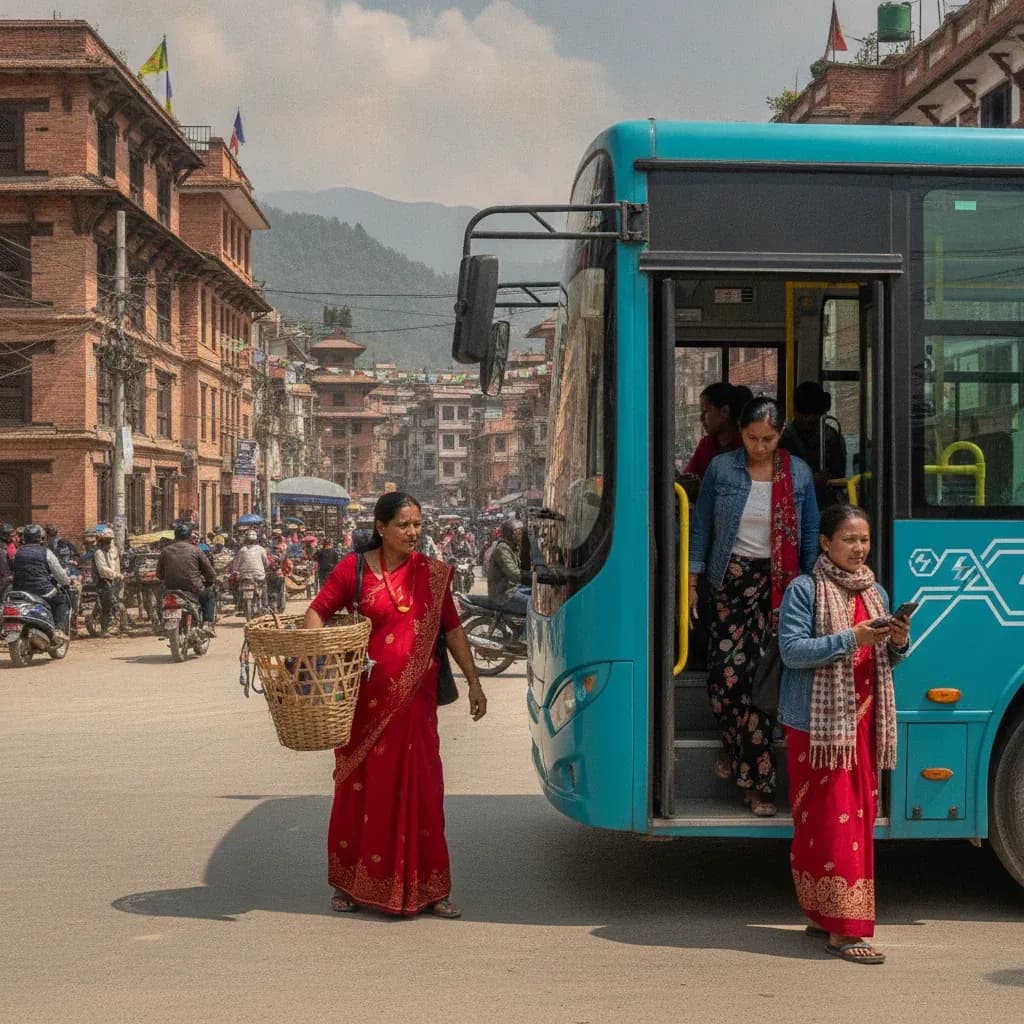
Nepal's Blue Bus: Free EV Rides for Women, Explained
Nepal's Blue Bus gives women free electric rides on 3 Kathmandu routes. Here are the routes, the delays, and what it means for EV public transit.
A New Kind of Electric Fleet Hits Kathmandu's Roads
The Blue Bus Nepal service quietly became one of 2026's most talked-about EV stories — not because it is a flashy new BYD or Leapmotor launch, but because it puts electric buses at the center of a government promise: free, safe public transport for women. Eight repurposed Sajha Yatayat electric buses, each seating 26 passengers, form the backbone of Phase 1, running on three Kathmandu Valley corridors at no cost to women riders. For a platform built around Nepal's EV transition, this is the story that shows electric mobility moving from personal purchase decisions into shared public infrastructure — and it comes with real growing pains.
What the Blue Bus Actually Is
The Blue Bus Nepal service is not a new bus brand or a repainting exercise — Sajha Yatayat publicly denied rumours that its green buses would be repainted blue. Instead, "Blue Bus" is a service designation: existing Sajha electric buses assigned to women-only, fare-free routes, identified by stickers and signage rather than a new paint job.
The Blue Bus initiative comes from Agenda 97 of the government's "100 Agendas for Governance Reform," and received formal funding through the national budget for fiscal year 2026/27. The long-term vision — female drivers and conductors, CCTV, GPS tracking, and an emergency assistance system on every unit — is meant to make the service feel meaningfully safer than Kathmandu's often-crowded standard routes, not just cheaper.
The Routes: Where Kathmandu's Blue Bus Runs Today
Phase 1 of the Blue Bus Nepal rollout concentrates all eight electric buses on three corridors:
- Budhanilkantha – Lagankhel – Godawari — 2 electric buses
- Nagdhunga – Tribhuvan International Airport — 2 electric buses
- Ring Road (full loop, roughly 27 km) — 4 electric buses
| Route (Phase 1) | Buses Assigned | Fare | Status |
| Budhanilkantha – Lagankhel – Godawari | 2 electric buses | Free for women | Phase 1 |
| Nagdhunga – Tribhuvan International Airport | 2 electric buses | Free for women | Phase 1 |
| Ring Road (full loop) | 4 electric buses | Free for women | Phase 1 |
A Second, Related Push: Sajha's Electric Night Bus
The Blue Bus isn't the only place Sajha's electric fleet is expanding into social infrastructure. Kathmandu Metropolitan City and Sajha Yatayat also run an electric night bus service on the Lagankhel–Budhanilkantha and Thankot–Tribhuvan International Airport (via Satungal) corridors, departing every 20 minutes until 11 PM, with CCTV and an onboard police officer on each bus. Sajha covered the operating cost through mid-2026, after which local governments were expected to share the expense. Together, the Blue Bus and the night bus program show the same electric fleet being stretched to cover two very different safety gaps — daytime fare access for women, and after-dark travel for everyone.
Why Electric Buses, and What They Actually Cost to Run
Running a Blue Bus in the Kathmandu Valley costs Sajha an estimated Rs 10,000–12,000 per bus per day, putting the annual bill for all eight Blue Buses at roughly Rs 30 million — fully covered by the government to keep rides free for women. That figure matters for BijuliSawari readers because it is a real, sourced data point on running an EV fleet in Nepal, not a manufacturer's brochure estimate.
The logic mirrors what BijuliSawari's own Fuel vs. Electric calculator shows at the personal-vehicle level: on Nepal Electricity Authority's domestic tariff (roughly NPR 10–12/kWh), a private EV typically costs about Rs 1–2 per km to run, against Rs 8–12 per km for a comparable petrol vehicle at current pump prices. Scaled up to a 26-seat bus carrying dozens of Kathmandu commuters per trip, that per-unit electricity cost advantage compounds fast — which is exactly why a fully-subsidized, fare-free electric service is financially plausible at Rs 30 million a year, a fraction of what an equivalent diesel fleet would cost in fuel alone.
| Mode | Typical Running Cost | Who Pays | Best For |
| Blue Bus (electric, women-only) | ~Rs 10,000–12,000/bus/day | Government (fully subsidized) | Free daily commuting for women on Phase 1 routes |
| Sajha electric Night Bus | Sajha-funded, shifting to shared local-government funding | Sajha Yatayat + local governments | Safe late-evening travel until 11 PM |
| Private EV (hatchback/SUV) | ~Rs 1–2/km on NEA domestic tariff | Owner | Long-term personal ownership, lower TCO than petrol |
| Petrol/diesel car | ~Rs 8–12/km at current fuel prices | Owner | Baseline most Kathmandu commuters are switching away from |
The Reality Check Competitors Are Glossing Over
Most Nepali auto outlets covered the Blue Bus Nepal launch as a straightforward good-news announcement. The more complete picture is messier — and more useful for readers trying to judge whether this program will last.
The July 17 target launch date slipped. As of early July, Sajha Yatayat CEO Bhupendra Aryal confirmed there was no formal agreement yet between the cooperative and the government, and that the service would only begin once budget approval and terms were finalised. That Blue Bus delay lines up with a well-documented pattern: Kathmandu has launched branded "free" or "special" bus services before — including earlier Rapid Bus and women-focused route attempts — that faded out within months once initial funding or political attention moved on.
That history is the real test for the Blue Bus. The government's own Blue Bus expansion plan is ambitious: a Cabinet-approved target of 25 Blue Buses within the first 100 days, with at least seven operating in the Kathmandu Valley through Sajha and at least eighteen more rolled out across all seven provinces via coordination with provincial transport associations. Whether that timeline holds — and whether local governments actually pick up their share of night-bus operating costs once Sajha's initial funding runs out — will determine if this becomes durable EV-powered public infrastructure or another short-lived pilot.
What This Means If You're Tracking Nepal's EV Transition
For BijuliSawari readers, the Blue Bus Nepal story is a useful data point beyond its social impact:
- It's proof electric buses like the Blue Bus are becoming Nepal's default choice for new public transit, not just a novelty — every unit deployed under this program and the night bus program is electric, not diesel.
- The Rs 10,000–12,000/day operating cost is a rare, real-world electric bus running-cost figure for Nepal, useful context if you're modeling fleet or taxi economics with BijuliSawari's TCO tools.
- Charging and depot capacity for this expanding electric fleet will matter — as more buses roll out across seven provinces, expect pressure on NEA's transport-tariff charging infrastructure alongside the private charging network BijuliSawari already tracks.
- The program's credibility is still being earned. Treat "free" and "launching soon" language from any Kathmandu transit announcement with the same healthy skepticism the delay history warrants.
The Bottom Line
Blue Bus Nepal is a genuinely new front in the country's EV story: electric vehicles as public safety infrastructure, funded by the state, not bought by a household. Eight electric buses now serve three Kathmandu Valley corridors free for women, with a stated goal of 25 buses across all seven provinces within 100 days — but a slipped launch date and Nepal's track record with short-lived "free bus" branding mean the real test is still ahead.
Whether you're a daily commuter watching for these buses on the Ring Road or an EV buyer curious about what public electrification actually costs to run, BijuliSawari will keep tracking the Blue Bus Nepal rollout alongside the country's broader charging network. In the meantime, use our Fuel vs. Electric Calculator to see exactly how much an EV — personal or shared — could save on your own daily commute.