
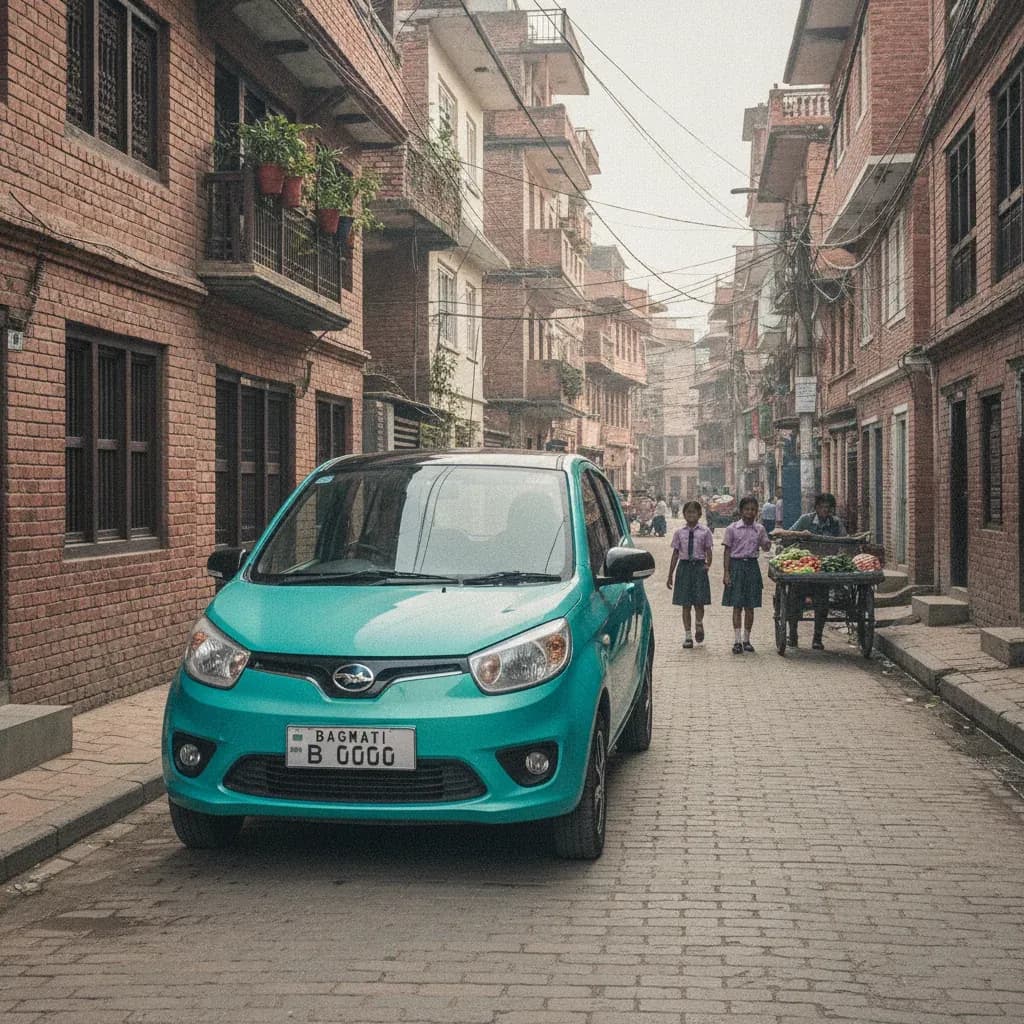
Honri Boma EV Nepal: Rs 20.99L Hatchback Debuts
V Auto's Honri Boma EV lands in Nepal at Rs 20.99 lakh with a 29.9kWh battery and 300km claimed range — ahead of its NAIMA 2026 debut on Aug 11.
Honri Boma EV Nepal Price and Launch Timeline
Generation Next Motors has confirmed the Honri Boma EV Nepal price at Rs 20,99,999 (introductory, ex-showroom), making the Chinese-built hatchback one of the most closely watched budget EV launches ahead of NAIMA Nepal Mobility Expo 2026. The five-door, five-seat city car — built by Rizhao Hongri New Energy Automobile under the V Auto brand — will make its public debut at Bhrikutimandap when the expo opens on August 11, running through August 16. In a market where electric vehicles now account for roughly three in every four new car imports, a fresh sub-Rs 21 lakh entrant lands at exactly the right moment for budget-conscious Nepali buyers.
"The Honri Boma EV has been introduced to meet the growing demand for smart, safe, affordable and environmentally friendly mobility solutions in Nepal," said Rakshit Bhimsaria, Director of Generation Next Motors, announcing the car's arrival.
Honri Boma Specifications: Battery, Motor and Charging Time
Here's what Generation Next Motors has disclosed so far:
- Battery pack: 29.9 kWh
- Motor: 35 kW (roughly 47 hp)
- Claimed range: up to 300 km per charge
- Home charging: approximately 7 hours from a standard household socket
- Body style: five-door hatchback, five-seat cabin
- Segment: compact urban city car
How the Honri Boma Stacks Up Against Nepal's Other Budget EVs
The Honri Boma doesn't enter an empty segment. Nepal already has a cluster of EVs priced between Rs 17 lakh and Rs 23 lakh, and the comparison is where its real story shows up.
| Model | Ex-Showroom Price (NPR) | Battery Pack | Claimed Range |
| Seres E1 | Rs 17.49 lakh | Not officially disclosed | 200 km |
| MG Comet EV (Pace) | Rs 19.99 lakh | 17.3 kWh | 230 km (ARAI) |
| V Auto Honri Boma | Rs 20.99 lakh | 29.9 kWh | 300 km (claimed) |
| Kaiyi e-Qute | Rs 22.96 lakh | 17.69 kWh | 200 km |
What It Actually Costs to Charge and Run the Honri Boma in Kathmandu
Using the 29.9 kWh pack and the claimed 300 km range, the Honri Boma consumes roughly 0.1 kWh per kilometre. Under NEA's current residential tariff — a progressive slab structure running from Rs 4/unit at the lowest tier up to Rs 11/unit above 250 units per month — a full home charge typically costs somewhere between Rs 240 and Rs 320, depending on how much electricity your household already uses that month. That works out to roughly Rs 0.90-Rs 1.10 per kilometre driven.
Compare that to a petrol hatchback: with petrol now at Rs 200 per litre in Kathmandu (effective August 3, 2026) and a typical small-car mileage of around 16 km/l, running costs work out to roughly Rs 12.50 per kilometre — more than ten times the Honri Boma's electricity cost per kilometre. Over 10,000 km a year, that's a running-cost saving in the range of Rs 1,00,000-Rs 1,15,000, before accounting for the EV's simpler servicing needs.
The Rs 20 Lakh Tax Cliff: Why This Price Point Matters
Here's the detail most coverage of the Honri Boma launch has missed entirely. Under Nepal's FY 2083/84 budget, EV import taxation moved to a value-based Clean Infrastructure Investment Fee (CIIF) applied on top of a flat 20% customs duty. The CIIF is tiered by the vehicle's CIF (customs, insurance, freight) value: just 2.5% for EVs valued up to Rs 20 lakh, but a steep 20% for the Rs 20-30 lakh band.
The Honri Boma's Rs 20.99 lakh retail price sits right on top of that boundary. That retail figure isn't the same as the CIF value the CIIF is actually calculated on — CIF value is typically lower than the final showroom price after duties, dealer margin, and VAT are added — so it's not automatic that the car falls into the higher tax band. But it does mean prospective buyers should ask Generation Next Motors directly which CIIF tier the Honri Boma has been classified under before assuming the introductory price is final. A car priced just above or just below that Rs 20 lakh CIF line can see a materially different landed cost, and that's exactly the kind of detail that separates an informed EV purchase in Nepal from an expensive surprise.
NAIMA Nepal Mobility Expo 2026: Where to See the Honri Boma
The Honri Boma's public debut coincides with what organizers are calling Nepal's largest-ever mobility exhibition. NAIMA Nepal Mobility Expo 2026 runs August 11-16 at the Bhrikutimandap Exhibition Hall in Kathmandu, with more than 55 brands and over 40 new vehicle launches expected across two-wheelers, four-wheelers, and commercial mobility. For buyers who want to sit inside the Honri Boma, compare it against the MG Comet EV or Kaiyi e-Qute in person, and ask dealers about financing and tax classification directly, the expo is the first real opportunity to do so.
BijuliSawari's Take: Is the Honri Boma Worth Considering?
The Honri Boma's biggest strength is straightforward: for buyers shopping under Rs 25 lakh, it currently offers the largest battery pack in its price class, which should translate to meaningfully better real-world range than the MG Comet EV or Kaiyi e-Qute even after adjusting for Nepal's hilly, stop-start driving conditions.
The caution is equally straightforward. Honri and its Nepali distributor, Generation Next Motors, are new names in a market where after-sales service network, spare-parts availability, and resale value matter enormously — and none of that has been tested yet. Buyers should also confirm DC fast-charging compatibility and warranty terms directly at the NAIMA stall, since the manufacturer's initial disclosure covers only home AC charging.
If a bigger battery at a competitive price matters more to you than an established brand name, the Honri Boma deserves a place on your shortlist. If service-network confidence is your priority, it's worth cross-checking it against BijuliSawari's Comparison Matrix and Total Cost of Ownership Dashboard before you commit — both tools let you weigh the Honri Boma against every other sub-Rs 25 lakh EV on the metrics that actually matter for Nepali roads: real-world range, boot space, ground clearance, and after-sales access.