
Nepal's EV Battery Crisis: What Every Buyer Must Know
Nepal's EVs have no recycling exit plan — 2.97M kWh of batteries hit end-of-life within 20 years. What the new CIIF tax means for buyers.
Nepal's EV Boom Has a Battery Problem Nobody Priced In
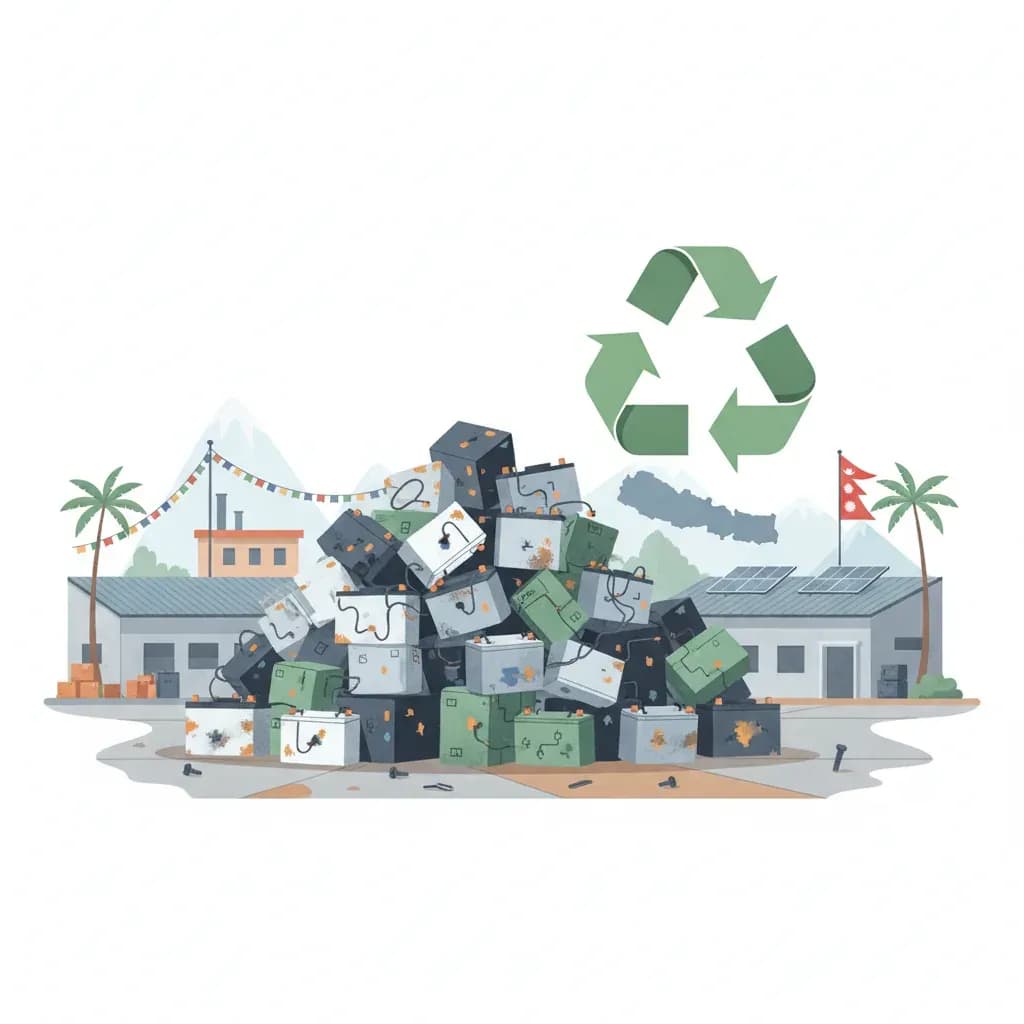
Walk into any dealership in Kathmandu right now and you'll hear the same pitch: an eight-year battery warranty, near-zero fuel cost, and a fresh tax break to sweeten the deal. What you won't hear is what happens after year eight. EV battery recycling in Nepal barely exists today — there is not one licensed facility in the country equipped to safely process a dead lithium-ion pack, even as electric vehicles now account for close to three-quarters of all new passenger vehicle imports. A government projection puts the scale of what's coming into focus: roughly 2,966,846 kWh of battery capacity from Nepal's current EV fleet is expected to reach end-of-life within the next 20 years. That's not a future problem. It's a countdown that started the day the first BYD and MG electric SUVs rolled off the ship at Birgunj.
How Big Is the Problem, Really?
Nepal's EV market has grown at a pace few countries have matched — import volumes have climbed by as much as 180 percent year-on-year in recent fiscal years, and EVs now make up nearly 75 percent of total passenger vehicle imports. Every one of those vehicles carries a lithium-ion pack weighing anywhere from 250 kg to over 500 kg, loaded with cobalt, nickel, manganese, and lithium salts that turn hazardous the moment they're dumped in a landfill or broken apart by informal scrap dealers, which is currently the only "recycling" option most dead packs in Nepal have.
Here's the gap that competitors covering the tax story have missed: nobody has connected what you pay at customs today to what happens to your specific battery a decade from now. That's the buyer-facing question BijuliSawari exists to answer.
What the 2025 Government Task Force Actually Found
In September 2025, Nepal's Ministry of Physical Infrastructure and Transport formed a task force to study the legal and institutional gaps around EV adoption — including, for the first time, end-of-life battery management. Its findings were blunt:
- There is no battery recycling policy in place anywhere in the country.
- No site has been designated for handling hazardous EV battery waste.
- No licensed or approved battery recycling facility currently operates in Nepal.
- A mandatory "take-back" policy requiring importers to either return spent batteries to the country of manufacture or recycle them domestically.
- An international-standard battery management and recycling center, built with donor assistance.
- Clear regulatory ownership — a defined answer to "who is responsible for your battery" that simply doesn't exist yet.
The Clean Infrastructure Investment Fee: Nepal's First Real Money for Battery Recycling
The fiscal year 2026/27 budget didn't wait for the task force's full report before acting — it created a funding mechanism instead. The old motor-power-based excise duty on EVs has been scrapped entirely, replaced by a value-based Clean Infrastructure Investment Fee (CIIF), collected at customs alongside the standard 20 percent duty.
| Customs Value (CIF) | Customs Duty | New CIIF | What Changed |
| Up to Rs 20 lakh | 20% | 2.5% | Entry-level EVs, smallest increase |
| Rs 20–30 lakh | 20% | 20% | New mid-tier bracket |
| Rs 30–40 lakh | 20% | 35% | Family SUVs feel this jump |
| Rs 40–50 lakh | 20% | 90% | Steep increase begins |
| Above Rs 50 lakh | 20% | 130% | Premium EVs hit hardest |
By the government's own statement, CIIF revenue is earmarked for three things: domestic EV assembly support, charging station expansion, and battery recycling management — the first dedicated funding line Nepal has ever created for this exact problem. NADA dealers have criticized the steep top-end rates, estimating price increases anywhere from Rs 2 lakh to over Rs 1 crore depending on the model. But strip away the sticker-shock headlines everyone else is running, and the more important story is this: a slice of every EV buyer's tax bill is now, at least on paper, meant to build the battery recycling infrastructure the 2025 task force said doesn't exist.
What This Means for You Before You Sign
If you're comparing EVs on BijuliSawari's listings or running numbers through the TCO Dashboard, add battery end-of-life to your checklist. Questions worth asking your dealer before you buy:
- Does the manufacturer's battery warranty (typically 8 years / 160,000 km) say anything about who removes and disposes of the pack afterward?
- Is there a written take-back commitment, or does the warranty simply end once capacity drops below the guaranteed threshold?
- If you sell the vehicle used, does the warranty — and any future take-back obligation — transfer to the new owner?
- Has the dealer disclosed the battery's chemistry and country of manufacture, which determines where a legally mandated return would even ship to?
Battery Warranty Is Not the Same as Battery Take-Back
This is the distinction almost every EV price story in Nepal glosses over. A battery warranty protects you against premature capacity loss — if your pack degrades below roughly 70 percent capacity before 8 years or 160,000 km, most manufacturers will repair or replace it. It says nothing about what happens to the old cells once they're pulled out. A take-back policy, the kind the government task force recommended but has not yet mandated, would obligate the importer or manufacturer to collect and responsibly recycle or export that battery. Until that becomes law, a dead EV battery in Nepal has nowhere guaranteed to go — which is exactly why the CIIF's recycling earmark matters more than its headline tax rate.
Global Lessons Nepal Can Borrow
Nepal isn't the first country to face this problem. A few models worth watching:
- India's Battery Waste Management Rules (2022) placed legal producer responsibility on manufacturers and importers — the same take-back mechanism Nepal's task force is now recommending.
- The EU's Battery Regulation requires a digital "battery passport" tracking chemistry, origin, and recyclability for every pack sold — a model that would pair naturally with BijuliSawari's own vehicle database.
- China's cascade utilization model repurposes retired EV packs for stationary grid and solar storage before final recycling, squeezing extra years of value out of a battery before it's broken down for raw materials — relevant given Nepal's own hydropower storage ambitions.
The BijuliSawari Bottom Line
Nepal's EV boom is real, and for the first time, the tax bill you pay today is genuinely earmarked to help close the recycling gap tomorrow. But until the take-back policy the 2025 task force recommended actually becomes law, the responsibility for asking the hard questions sits with you, the buyer. Before you finance your next EV, run the numbers on BijuliSawari's TCO Dashboard — it already factors in battery degradation and potential replacement cost around year 7–8, so the recycling gap the government hasn't solved yet doesn't become a cost surprise you didn't plan for. And keep an eye on our News Hub — the day Nepal licenses its first EV battery recycling facility, you'll read it here first.